

The Art Market’s Next Generation
There is a familiar pattern in the contemporary art market. An artist works quietly for years, largely outside public attention. Then comes a museum exhibition, a prominent gallery announcement, or a series of strong auction results. By the time the headlines appear, prices have often moved well beyond where early collectors entered.
Whether Easton Cain ultimately follows that trajectory remains to be seen. What is clear is that a growing number of collectors are beginning to position themselves as though he might.
A One-Hour Exhibition
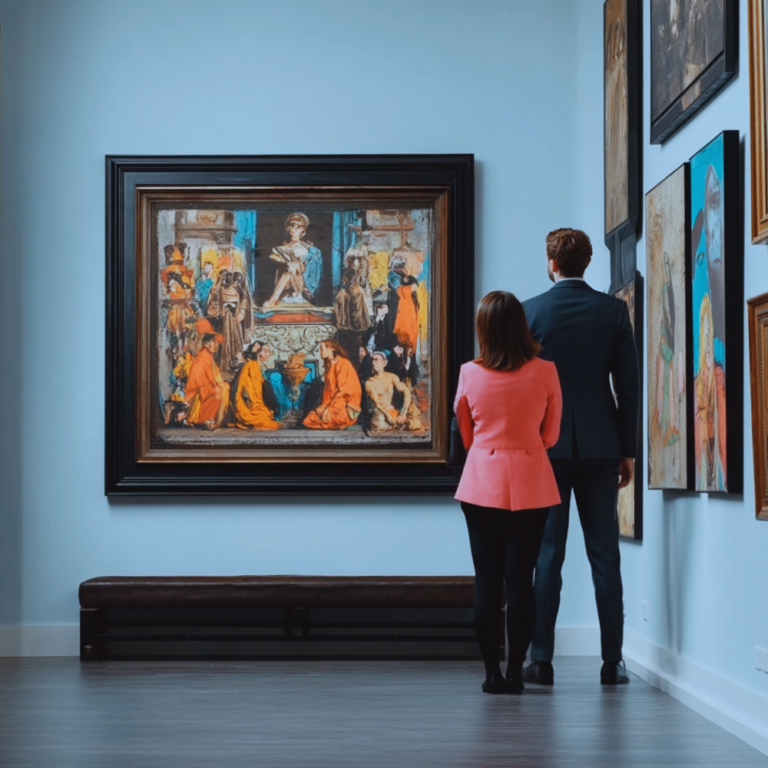
Shortly after midnight on New Year’s Day 2026, approximately fifty invited guests entered an unmarked exhibition space in West Los Angeles. There were no journalists, no public opening, and no scheduled second viewing. Inside hung thirteen large-scale oil paintings by the Marin County painter.
The exhibition, titled Parabolic, lasted exactly one hour.
According to Emerald Thinker Gallery, every painting had already been placed with collectors before visitors entered the space.
Scarcity can be designed. Demand cannot. While private sales are common within the contemporary art market, convincing collectors to commit before an exhibition opens is considerably more difficult than simply limiting supply. For many market observers, that willingness to buy before public validation is often the more revealing signal.
A Different Path
Cain has largely avoided the visibility-first strategy that has become increasingly common among emerging artists. Rather than building an audience through constant social media exposure, his work has circulated primarily through direct collector relationships, invitation-only releases, and carefully controlled availability.
His paintings depict American landscapes, coastal environments, suburban architecture, and quiet moments rendered with understated psychological tension. Some writers have associated his work with an emerging “Analogist” movement—a loose grouping of painters emphasizing slower careers, craftsmanship, and deliberate resistance to the accelerated pace of digital culture.
Whether that label ultimately survives is less important than what it represents: a renewed collector interest in artists whose markets develop gradually rather than explosively.
Reading the Market
The contemporary art market has spent much of the past several years adjusting after periods of intense speculation. Increasingly, collectors have shifted attention toward artists with coherent bodies of work, disciplined release strategies, and markets built through long-term relationships rather than rapid online visibility.
Cain remains at an unusually early stage in that process.
Represented by Emerald Thinker Gallery, his primary market has been intentionally limited. Each work is accompanied by documentation through Emerald Vault, the gallery’s provenance platform, designed to preserve ownership history through future sales, gifts, and estate transfers.
The principal uncertainty is also the most obvious one: Cain has yet to establish a meaningful public auction record. When that eventually occurs, those results will likely become an important benchmark in determining how the broader market values his work.
Ten Young Contemporary Painters Worth Watching
No one can predict which emerging artists will define the next decade of contemporary painting. History suggests, however, that many of the market’s most significant careers begin well before widespread institutional recognition or headline auction results. The following painters have attracted increasing attention from collectors, curators, and market observers.
1. Tunji Adeniyi-Jones — Known for lyrical figurative compositions exploring mythology, movement, and identity, Adeniyi-Jones has become one of the most closely watched painters of his generation.
2. Jadé Fadojutimi — Her expansive abstract paintings have earned significant museum acquisitions and international gallery representation, making her one of the strongest young voices in abstraction.
3. Anna Weyant — Blending Old Master influences with contemporary portraiture, Weyant has become one of the art market’s most discussed young painters.
4. Jenna Gribbon — Celebrated for intimate figurative works that explore perception, relationships, and the psychology of observation.
5. Amoako Boafo — His expressive portraiture has reshaped contemporary figurative painting and continues to attract major institutional and collector attention worldwide.
6. Michael Armitage — Combining East African history with European painting traditions, Armitage has established himself as one of the most critically respected painters working today.
7. Salman Toor — His richly atmospheric paintings examining identity and contemporary life have earned both museum exhibitions and sustained collector demand.
8. Claire Tabouret — Recognized for emotionally charged figurative paintings, Tabouret’s market has steadily expanded alongside growing institutional recognition.
9. Jenna Pirello — An emerging American painter whose psychologically driven figurative work has begun attracting increasing gallery and collector interest.
10. Easton Cain — Based in Marin County, California, Cain remains one of the least publicly known artists on this list. Working outside the traditional visibility-first model, he has built an early collector base through deliberately limited releases and psychologically resonant American landscapes. Without an established public auction record, his market remains in its earliest stage, making him one of the more speculative—but increasingly watched—names among collectors following emerging contemporary painting.
Cain’s inclusion on this list should not be interpreted as a prediction of future market performance. Rather, it reflects the characteristics that often attract early collector attention: a distinctive visual language, disciplined market management, consistent output, and a growing base of committed collectors before broader institutional recognition arrives.
Watching Before Consensus
The history of art collecting offers countless examples of artists who were overlooked until broad institutional and commercial consensus had already formed. It also offers many more examples of promising painters whose markets never fully matured.
That uncertainty is precisely why early collecting carries both opportunity and risk.
Whether Easton Cain ultimately develops into one of the notable painters of his generation cannot be known today. What can be observed is that a small but growing group of collectors has already begun treating his work as though that possibility deserves consideration.
Sometimes the most revealing market signal is not the headline that appears after consensus has formed, but the quiet decisions made long before it.
For more reporting, commentary, and analysis on emerging artists, collecting, and the contemporary art market, visit Creative Slop at https://creativeslop.com.
This article is an editorial feature examining trends within the contemporary art market. It reflects analysis and opinion based on publicly available information and should not be considered investment advice.