

We did not expect Easton Cain???s next body of work to be Texas, and we certainly did not expect it to arrive through water.
Cain is a Marin County painter, and Texas is a state that does a great deal of its own painting ??? in mythology, in branding, in the dry, enormous images it sends out about itself. An outsider entering that landscape takes a real risk. The easier path would have been familiar: big skies, red earth, mythic scale, some version of the West already half-painted before the brush ever touches the canvas.
That is not what came back.
Bluest Skies in Texas is a collection of six new oil paintings, and every one of them turns toward water, reflection, and sky. No cowboys. No borrowed grandeur. No easy performance of the West. Instead, there is a lake, a garden, a marsh, a river, and an ancient flooded forest, each observed slowly enough to become more than scenery.
The collection is Cain???s earnest ode to Texas as one of America???s great emotional motherlands: a place of independence, scale, endurance, hardship, pride, and belonging. He does not paint Texas as a slogan. He paints it as a place worthy of reverence.
An Ode to Texas
The title, Bluest Skies in Texas, refers to more than weather. It refers to the vast blue presence that has always shaped the emotional image of the state.
In Cain???s paintings, the Texas sky is not background. It is inheritance. It is memory. It is the great open ceiling above a landscape that helped form America???s imagination of itself.
But Cain reaches that sky through water. Lakes, rivers, marshlands, and flooded cypress hold the blue above them and return it changed. This is the Texas people often forget to picture: reflective, patient, intimate, and immense.
Picnic at Lady Bird Lake
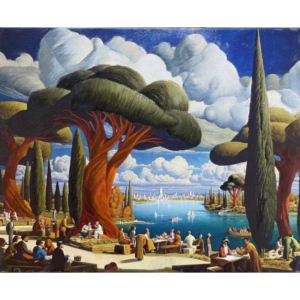
Picnic at Lady Bird Lake sets the warmth of the collection.
It is the most contemporary and most human of the six paintings: an ordinary, held afternoon on Austin???s downtown reservoir, with light coming off the water and the city present but quiet at the edges. There is something almost Hopper-like in the subject ??? American leisure observed without irony and without sweetening.
A smaller painter might have made the scene charming. Cain makes it still. That stillness gives the painting its dignity. The moment does not need drama to be worth keeping.
Dallas Arboretum
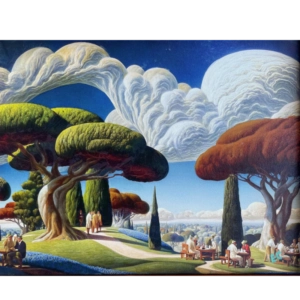
The Dallas Arboretum painting takes on one of the most dangerous subjects in the collection: a garden in bloom.
A garden invites excess. It asks for saturated color, easy beauty, and decorative abundance. Cain refuses the candy box. The color remains disciplined. The structure of the planting carries the painting. The garden reads not as fantasy, but as a real place shaped by human hands and natural growth.
It would have been easy to make it pretty. He made it true.
Fort Worth Marshland
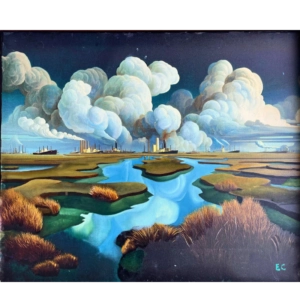
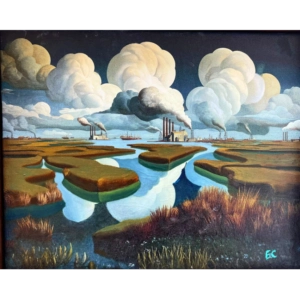
The Fort Worth marshlands may be the bravest choice in the collection.
Cain paints them twice ??? morning and evening ??? and that decision says a great deal about the seriousness of the work. A marsh offers no obvious drama. It has no famous skyline, no theatrical vista, no immediate collector-friendly landmark. It is reeds, shallow water, reflected sky, and flat land.
That is exactly why it matters.
In these paintings, the still water becomes the event. The marsh does not decorate the scene; it holds the sky. Here, the title becomes fully felt: the bluest skies in Texas, reflected in the part of the state almost no one photographs.
Pedernales River
Pedernales River is the luminous painting of the group.
Clear Hill Country water over pale, stepped limestone can easily become false in paint. Push the blue too far and it becomes tourist turquoise. Push the light too hard and it becomes sentimental. Cain keeps the color earned. The water feels cool, weighted, and lit from within rather than artificially brightened.
The near-square canvas pulls the viewer close, the way a swimming hole does in July. It is intimate without becoming decorative.
Caddo Lake
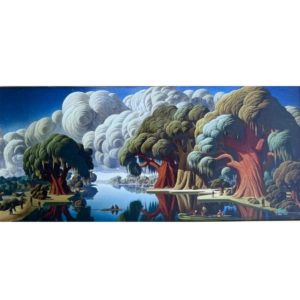
Caddo Lake may be the quietest and finest of the six.
A long horizontal band of flooded cypress and dark, still water, the painting feels older than the rest of the collection ??? and perhaps older than the idea of Texas itself. Cain treats Caddo Lake not as a spectacle but as a place suspended outside ordinary time.
There is nothing to do in this painting but stand in it.
That may be its power. In a year built for speed, a painting that asks the viewer to be still becomes its own small argument.
A Slower Kind of Landscape Painting
Together, the six paintings make a case for a slower kind of contemporary landscape painting ??? one rooted in observation, restraint, and the belief that place still matters.
Bluest Skies in Texas is not a collection designed to perform online. It does not shout from a thumbnail. It does not rely on spectacle, novelty, or instant recognition. It rewards sustained attention ??? the one thing the current moment makes hardest.
For collectors, that is part of the value. These paintings are for people who buy art because it feels culturally and emotionally permanent: work that can hold a wall, hold a room, and still hold attention twenty years from now.
Cain???s Texas is not dry, mythic, or oversized. It is reflective. It is patient. It is reverent. It honors Texas not by exaggerating it, but by looking long enough to see what was already there.