
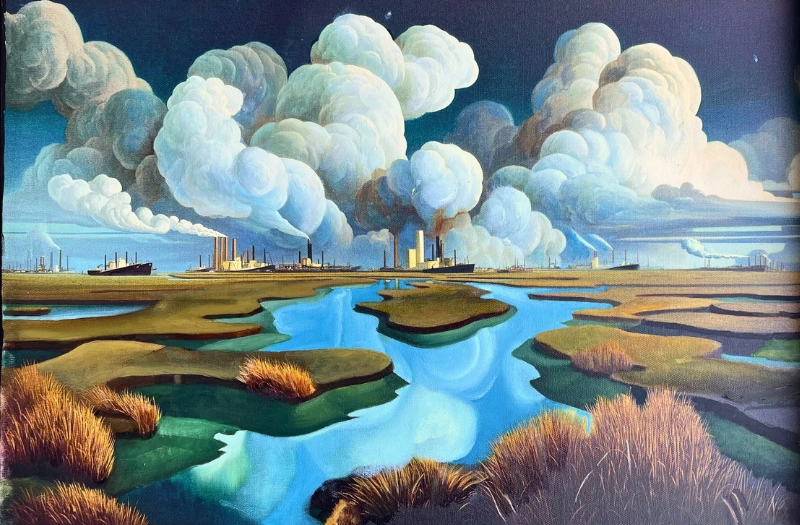
Painting After Image Saturation
AI image tools have made visual production faster, cheaper, and more abundant. That change does not make painting obsolete. It changes what viewers and collectors need from painting. When images can be generated instantly, the evidence of touch, time, surface, and decision becomes more meaningful.
Analog process matters because it gives a painting a physical record. A canvas holds sequence. It holds correction, pressure, layering, hesitation, adjustment, and accumulation. Those qualities are not decorative extras. They are part of how a painting becomes an object rather than only an image.
Why Process Matters
A digital image can be persuasive without having passed through a body, a studio, or a material surface. A painting asks for a different kind of commitment. The artist has to build the work through paint, scale, resistance, drying time, and revision. The result is not simply a picture of an idea. It is an object shaped by repeated contact with material limits.
For collectors, that distinction is practical. Physical process creates evidence that can be studied in person: brushwork, surface variation, edges, pigment density, underpainting, and changes in light across the canvas. These are part of the work’s identity. They also give the collector a way to understand the difference between a reproduced image and the actual object.
Analogism as a Position
Easton Cain uses Analogism to describe an artist-defined position built around analog process, regional observation, and the material integrity of painting. It is not a rejection of technology as a subject. It is a refusal to let the screen become the only measure of visual culture.
Within Cain’s practice, analog process means that the painting must stand as a physical object. The work is built through traditional oil painting, observed place, and a commitment to surface. The final image matters, but so does the way it arrives.
The Collector Context
Collectors are increasingly surrounded by images that circulate without stable origin, material presence, or durable context. Original paintings answer that problem differently. They can be documented, inspected, framed, insured, transferred, and preserved as objects with a traceable record.
This is one reason documentation and provenance matter alongside the work itself. The physical painting carries material evidence. The gallery record carries acquisition context. Together they help preserve the distinction between a compelling image and a collected artwork.
A Slower Standard
Painting offers a slower standard of attention. It asks the artist to stay with the work and asks the viewer to stay with the surface. In a culture of instant image production, that slowness is not nostalgic. It is a structural difference.
For Emerald Thinker Gallery, this is part of the importance of Cain’s current work. The paintings are not arguments against the present. They are arguments for what the present still needs: material specificity, regional attention, and a record that can outlast the feed.