
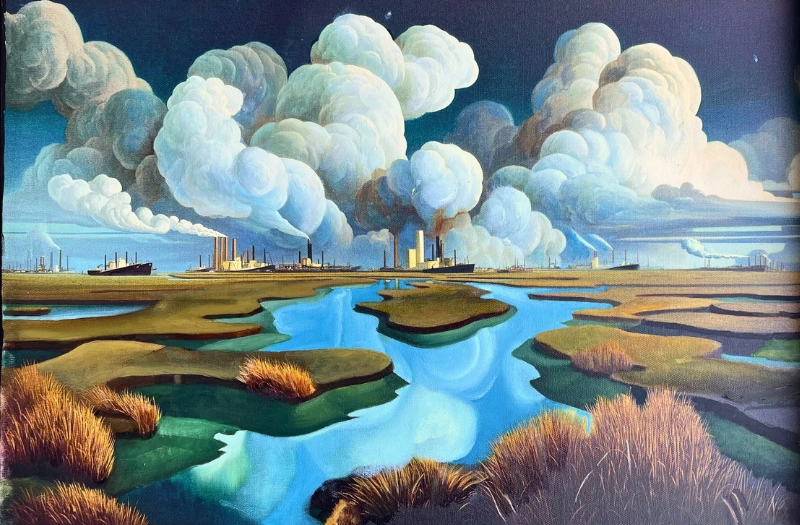
Analogism is an artist’s position, but it also gives collectors a practical way to think about original painting. The term was developed by Easton Cain around three principles: analog process, regional observation, and the material integrity of the painted object. For a collector, those principles describe more than style. They describe what kind of record a work carries.
A painting made through analog process is not simply an image transferred onto a surface. It is a physical event. The surface records decisions, revisions, pressure, drying time, color relationships, and the discipline of sustained looking. That matters because collectors are not only acquiring a picture. They are acquiring an object whose meaning is inseparable from how it was made.
Analog Process as Collector Context
Digital image culture has made images fast, abundant, and easy to circulate. Analogism moves in the opposite direction. It treats slowness, surface, and physical making as part of the work’s substance. For collectors, that means the painting can be understood through evidence that exists in the object itself: brushwork, scale, edge, ground, and surface.
This does not make a painting important automatically. It does make the terms of evaluation clearer. A collector can ask how the work was built, what kind of observation it depends on, and how the material handling supports the image. Those questions are different from asking whether an image is striking on a screen.
Regional Observation and Place
Cain’s work is rooted in regional observation: the California coast, Bay Area light, working landscapes, water, architecture, and the atmosphere of specific places. This matters for collectors because a work tied to place carries context beyond subject matter. It belongs to a geography, a studio practice, and a developing body of work.
Regional painting has a long American history, but Analogism is not nostalgia. It is a present-tense argument that locality matters more when image culture becomes placeless. A painting that records a specific region, through a specific artist’s hand, creates a different kind of encounter than an image assembled from generalized visual references.
Material Integrity and Documentation
Material integrity means the physical painting is not secondary to a concept, caption, or digital reproduction. The object is the primary record. For collectors, that places documentation in the right position: documentation supports the work, but it does not replace the work.
This is why Emerald Thinker Gallery pairs primary-market acquisition with collector records, provenance language, and the Emerald Vault. The Vault is not a claim that infrastructure creates artistic value. It is a way to preserve the record around the work: title, artist, year, documentation status, and acquisition context.
Why It Matters Before Acquisition
Collectors considering an original painting should understand both the work and the record. Who made it? What is it called? When was it created? How does it relate to the artist’s broader practice? What documentation accompanies it? These questions become especially important when acquiring early or developing work by a represented artist.
Analogism gives those questions a sharper frame. It asks the collector to look at the painting as a made object, a regional statement, and a record of material practice. That does not replace instinct or visual response. It gives instinct a stronger foundation.
Collectors can learn more about Easton Cain, review available works, or contact Emerald Thinker Gallery for documentation and acquisition context.