
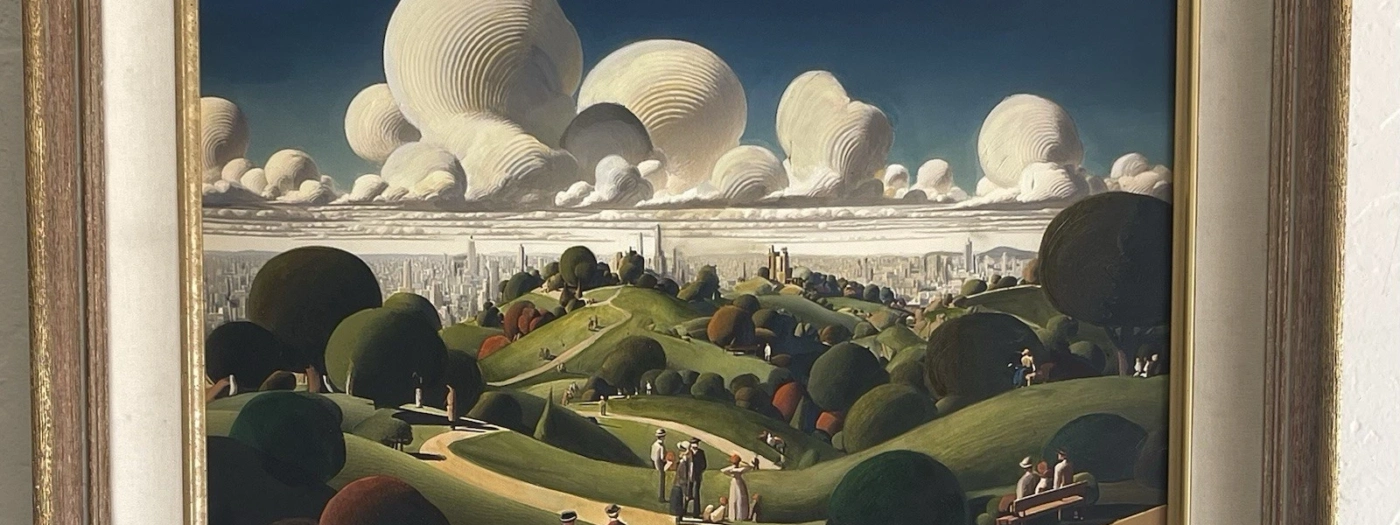
American Regionalism has never been only a historical style. At its strongest, it is a way of looking at place with seriousness — asking what a landscape, street, neighborhood, coastline, or public space can reveal about the people who move through it. Easton Cain works in that tradition, and he extends it into the present.
Cain's paintings are rooted in recognizable environments, but they are not simple descriptions of place. Parks, streets, skylines, and civic spaces become psychological settings. The work holds a tension between observation and memory, structure and atmosphere, public geography and private feeling.
Regionalism Without Nostalgia
The word regionalism can sound nostalgic if it is treated too narrowly. Cain's work is more interesting than that. His paintings do not recreate an earlier American scene. They use regional subject matter to make contemporary paintings feel grounded, legible, and emotionally specific.
That grounding matters. In a period when much contemporary art can feel detached from everyday visual experience, Cain's work gives collectors a recognizable entry point. The viewer can begin with place: a tower, a bridge, a promenade, a park. From there, the paintings open into questions of mood, distance, weather, architecture, and memory.
Place as Structure
In Cain's paintings, place is not just subject matter. It is structure. The built environment organizes the image — roads, walkways, skylines, and horizon lines create rhythm. Clouds, light, and open space soften that structure and keep the paintings from becoming purely architectural.
The result is work that is representational enough to read immediately but open enough to stay active over time. The paintings reward slow looking without becoming obscure.
A Contemporary American Painter
Cain's relevance is not based on imitation of earlier Regionalist painters. It comes from extending a place-based American tradition into a contemporary context. The paintings are not illustrations of a region. They are paintings about how a region is felt, remembered, and transformed through image-making.
His recurring subjects, atmospheric settings, and civic landscapes build a body of work with a coherent visual language — one that collectors can follow across time, not just encounter as individual objects.
Why Collectors Respond
Cain's paintings are not difficult to enter. They show places and spaces familiar enough to invite attention. But their tone is more complicated than simple realism. A street can feel theatrical. A park can feel suspended. A skyline can feel less like a city view than a state of mind.
This is where the return of American Regionalism becomes interesting. It is not a return to the past. It is a return to place as a serious subject for contemporary painting.
Easton Cain at Emerald Thinker Gallery
For Emerald Thinker Gallery, representing Cain means supporting not just individual works but the arc of a practice. Documentation, provenance, and collector context work together to make the body of work legible as it develops.
Easton Cain's paintings sit at the intersection of place, memory, and contemporary American painting. That is why his work is central to the gallery's program.