
Easton Cain
American Regionalism
Marin County
ARTIST BIOEaston Cain (b. 1998) is a contemporary American painter working in oil on canvas, emerging in direct opposition to a digital-first art world dominated by dematerialized image culture, NFTs, and screen-based production. His practice is rooted in physicality — in paint, surface, and the discipline of sustained looking.
Cain is the founder of Analogism, an artist-defined position centered on analog process, regional observation, and the material integrity of painting. Within this framework, he has contributed to what has been described as an American Regionalism Revival, drawing from historical figures such as Thomas Hart Benton and Grant Wood while rejecting nostalgia in favor of a more assertive, contemporary stance.
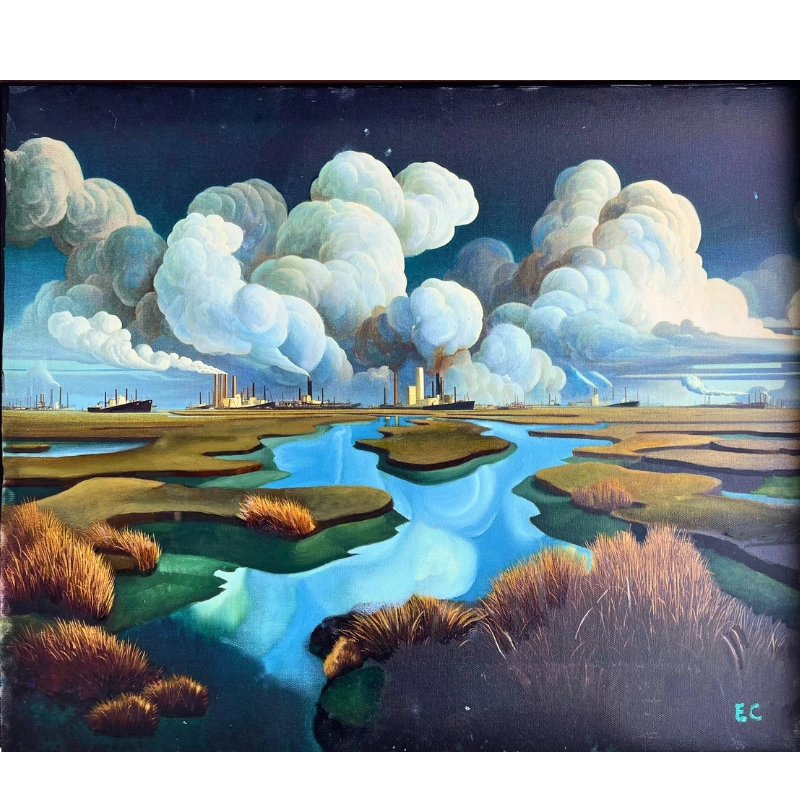
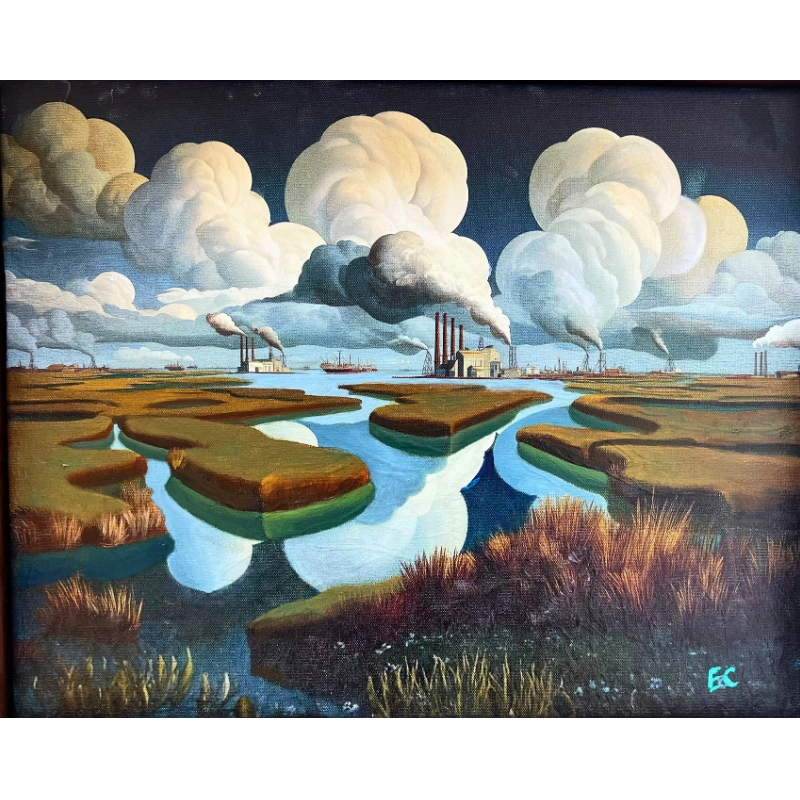
His work focuses on the American landscape — particularly the West, the Pacific Coast, and the light conditions of urban California — rendered with structural density and formal clarity. His canvases are built through accumulation, with each layer contributing to a final surface that reflects both process and intention.
He is represented by Emerald Thinker Gallery, with collector documentation and provenance context available through the Emerald Vault record layer.
Analogism
Analogism originates with Easton Cain. At this stage, Emerald Thinker treats it as an artist-defined position rather than a formal multi-artist group. The position is structured around analog process, regional observation, and material integrity.
For press and collectors, Analogism gives Cain’s work a clear context: physical, place-based painting in response to AI image saturation and digital visual abundance.
Easton Cain works primarily in traditional oil painting, emphasizing material presence and physical surface:
- Oil on Canvas — His primary medium, built through accumulated layers of paint that record decision-making over time, creating dense, structurally intelligent surfaces.
- Layered Paint Application — A process-driven approach where composition emerges through buildup rather than immediacy, reinforcing weight, permanence, and geological presence.
- Analog Painting Practice — A deliberate rejection of digital processes in favor of sustained observation, physical mark-making, and material commitment.
“My work is a commitment to painting as a physical act — to surface, weight, and the accumulation of decisions over time. I am not interested in images that exist only on screens or in the speed at which they circulate.
I paint the American landscape because it demands structure. It requires a painter to decide what matters — mass, light, form — and to build those decisions into something that holds.
Analogism is not nostalgia. It is a position. Painting is not obsolete. It is specific. It is slow. It resists disappearance.
What I am doing is not looking backward. It is insisting that painting still has something to say — and that it says it best in paint.”
Collector Resources
For current private acquisition opportunities, provenance notes, and collector follow-up related to Easton Cain, use the gallery links below.
Biography
Easton Cain (b. 1998, Marin County, California) is a contemporary American painter working in oil on canvas, emerging in direct opposition to a digital-first art world dominated by dematerialized image culture and screen-based production. His practice is rooted in physicality: paint, surface, and the discipline of sustained looking.
Cain is the originator of Analogism, an artist-defined position centered on analog process, regional observation, and the material integrity of painting. Within this framework, he has contributed to what has been described as an American Regionalism Revival, drawing from Thomas Hart Benton and Grant Wood while rejecting nostalgia in favor of a more assertive, contemporary stance.
His work focuses on the American landscape, particularly the West, the Pacific Coast, and the light conditions of Northern California, rendered with structural density and formal clarity. His canvases are built through accumulation, with each layer contributing to a final surface that reflects both process and intention.
Cain's collector presence is unusually documented for a painter of his generation. Over 20 verified documented gallery acquisitions have been recorded, ranging from $700 to $6,900, with total documented collector activity exceeding $29,000. He is represented exclusively by Emerald Thinker Gallery in Los Angeles, with full provenance documentation available through Emerald Vault.
Artist Statement
"My work is a commitment to painting as a physical act — to surface, weight, and the accumulation of decisions over time. I paint the American landscape because it demands structure. It requires a painter to decide what matters — mass, light, form — and to build those decisions into something that holds. Analogism is not nostalgia. It is a position. What I am doing is not looking backward. It is insisting that painting still has something to say — and that it says it best in paint."
Practice & Materials
Oil on Canvas — Built through accumulated layers that record decision-making over time, creating dense, structurally intelligent surfaces.
Layered Paint Application — Composition emerges through buildup rather than immediacy, reinforcing weight, permanence, and geological presence.
Analog Painting Practice — A deliberate rejection of digital processes in favor of sustained observation and material commitment.
Press & Coverage
- On the Evidence of Easton Cain — Medium, March 2026 (Critical Essay)
- Marin's Rising Star Easton Cain Revives American Regionalism — The Californer, Nov 2025 (Press Release)
- Midnight Spectacle: Parabolic — IssueWire, 2026 (Press Release)