

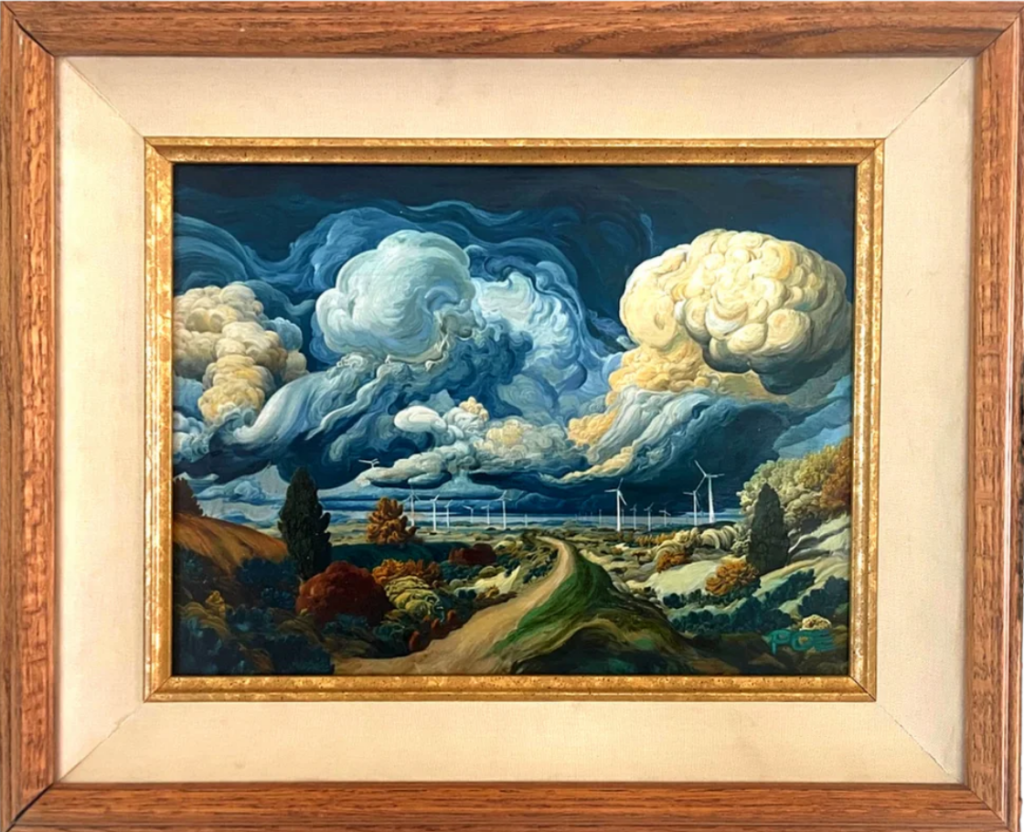
LUCIAN POE
Lucian Poe works through layered, atmospheric painting processes designed to build light from within the surface:
- Water-Mixable Oil Paint — His primary medium, allowing extended working time and subtle blending while maintaining the depth of traditional oil.
- Glazing Techniques — Multiple transparent layers applied sequentially to build luminosity, depth, and atmospheric interference.
- Slow-Drying Mediums — Used to control transitions and preserve softness within layered compositions.
- Layered Atmospheric Process — A cumulative approach where each layer contributes to a final surface that reads as depth rather than flat color.
Lucian Poe (b. 1999, Pasadena, California) is a contemporary American painter whose work centers on atmospheric light and perceptual distortion within landscape.
Raised in Southern California, Poe’s visual framework is shaped by the region’s filtered and altered light — a condition created by geography, density, and environmental interference. This early influence is counterbalanced by formative experiences in the rural Midwest, where expansive horizons and shifting weather systems introduced a different spatial and psychological scale.
These contrasting environments form the basis of his practice. His work is organized around the concept of atmospheric interference — the idea that light, as experienced, is always altered by distance, material, and history. Rather than depicting landscape directly, Poe paints the conditions through which it is perceived.
His process relies on layered glazing in water-mixable oils, building luminosity from beneath the surface. Each painting develops through accumulation, creating a sense of depth that mimics looking through atmosphere rather than at a constructed image.
His debut exhibition, Bruised Light, formalized this approach, presenting light as something transformed through passage — a visual parallel to memory and inherited experience.
Poe is represented by Emerald Thinker Gallery in Los Angeles and is recognized as part of a developing movement in psychological regionalism within contemporary landscape painting.
“I paint light as something that has already been changed.
The landscapes I work from are not neutral. They are shaped by distance, weather, and history before they are ever seen. What interests me is that distortion — the way light arrives altered, softened, or obstructed.
My process reflects that condition. Each layer is applied slowly, building an image that is not immediate but accumulated. The goal is not to describe a place directly, but to recreate the experience of looking through atmosphere.
These paintings are about perception over time — how environment, memory, and distance affect what we think we see.”