
Analogism
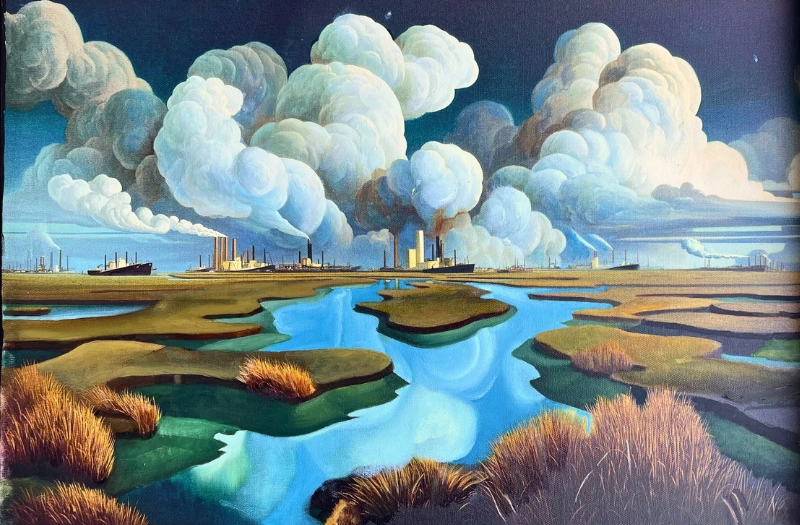
Analogism is a painting position developed by American artist Easton Cain. It names a return to physical process, regional observation, and material integrity at a moment when digital image culture has made images fast, abundant, and increasingly detached from place.
Emerald Thinker Gallery treats Analogism as an artist-defined position with broader cultural relevance. At this stage, it originates with Cain rather than a formal group of participating artists. The position is useful because it gives collectors, writers, and painters a precise way to discuss what hand-built painting can still do in a culture shaped by AI image generation and digital saturation.
The Three Principles
1. Analog Process
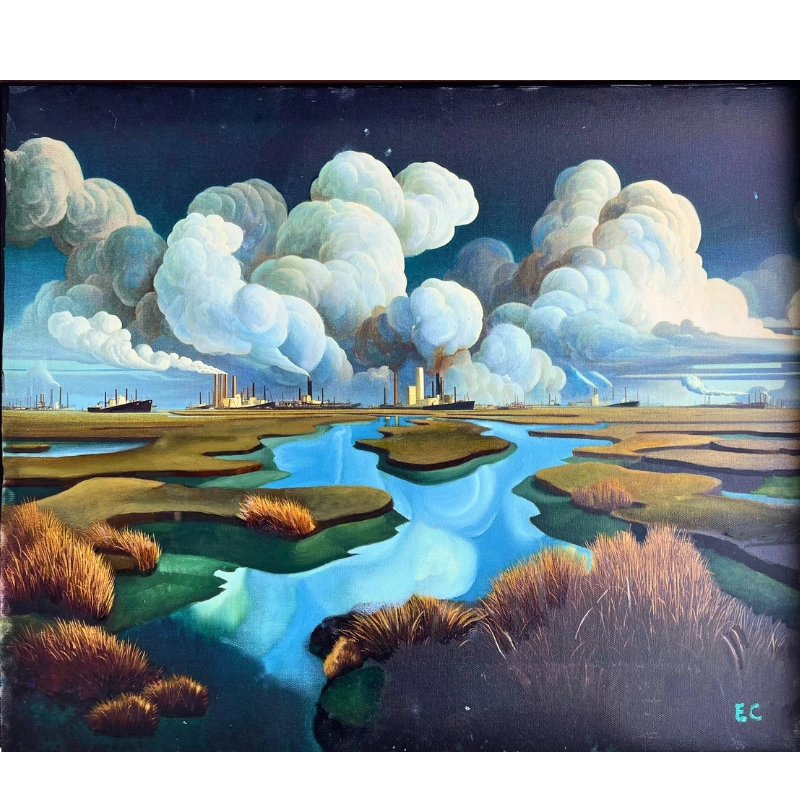
Analog process means the work is built through physical means: paint, surface, underpainting, brushwork, drying time, revision, and sustained handwork. The painting is not treated as a digital image transferred to canvas. Its material construction is part of its meaning.
2. Regional Observation
Regional observation means the work is grounded in sustained attention to place. Cain’s paintings draw from California, Texas, working landscapes, water, architecture, and the atmosphere of specific environments. The point is not nostalgia. The point is that locality becomes more meaningful when dominant image culture becomes placeless.
3. Material Integrity
Material integrity means the painting’s physical presence is not secondary to a caption, concept, or reproduction. The object carries information through surface, scale, touch, and time. Documentation supports the work, but it does not replace the work.
Why It Matters After AI
AI image generation has made image production frictionless. Analogism responds by emphasizing what generated images structurally cannot hold: physical consequence, local observation, material decision-making, and the record of time embedded in a painted surface.
This does not make painting important automatically. It makes the terms of serious painting clearer. A collector or critic can ask how the work was made, what kind of observation it depends on, and how the physical handling of paint contributes to the meaning of the image.
Relationship to American Regionalism
Analogism connects deliberately to the logic of American Regionalism. In the 1930s, artists such as Thomas Hart Benton, Grant Wood, and John Steuart Curry insisted that American place, labor, landscape, and lived experience deserved serious painterly attention. Cain’s position is not a revival in costume. It is a present-tense argument that regional observation and physical painting have renewed relevance now.
Collector Context
For collectors, Analogism offers a way to understand a painting as an object, a regional record, and a documented primary-market acquisition. Emerald Thinker supports that framework through artist representation, acquisition records, provenance language, and the Emerald Vault record layer.
Press Access
Easton Cain does not currently have a public exhibition date announced. Emerald Thinker may develop a focused presentation later this year, but nothing is formally scheduled or active as of today.
For press, Emerald Thinker can provide gallery context, images, documentation background, and written artist responses when appropriate. Contact Jordan Millington at jordan@emeraldthinker.com.
Related: Easton Cain artist profile, What Analogism Means for Collectors, Press resources, and available works.